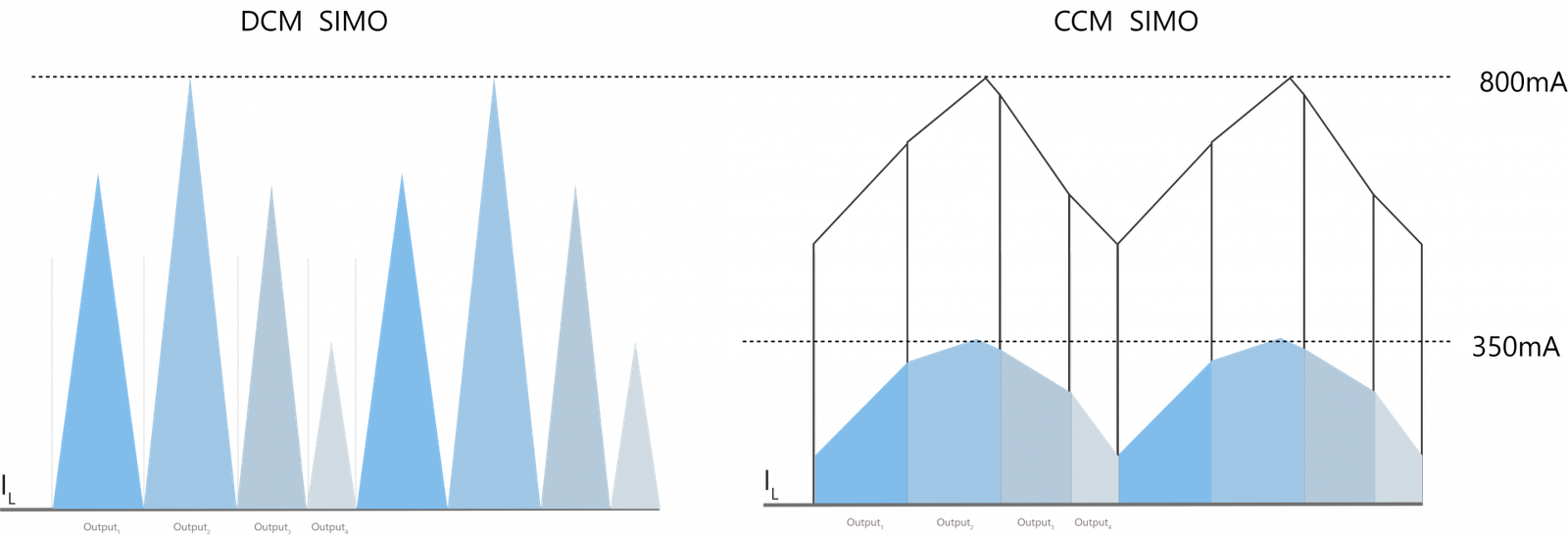


What is CCM SIMO?
In traditional switching regulator topologies, each output requires a separate inductor. These inductors occupy large board area and increase cost, making them less ideal for compact devices. Linear regulators offer advantages such as fast response, compact size, and low noise, but they suffer from higher power loss.
Another option is to combine multiple low dropout regulators (LDOs) with DC/DC converters, but this results in a larger overall footprint compared to using LDOs alone. As illustrated below, for a four-channel configuration, conventional power solutions require multiple inductors.
Traditional Architecture

Bravotek Architecture
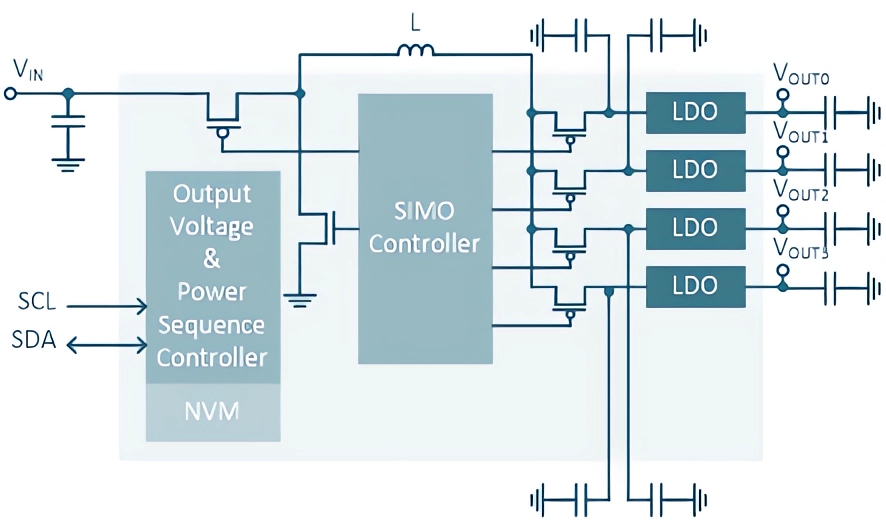
Bravotek’s SIMO architecture provides the optimal power solution for compact devices that require smaller PCB size without compromising efficiency. By reducing the number of required inductors while maintaining the efficiency of a switching converter, the SIMO architecture offers an almost ideal topology for space-constrained applications.
SIMO converters operate in two conduction modes: Continuous (CCM) and Discontinuous (DCM). Bravotek’s patented design adopts the CCM approach, which is significantly more complex to implement than the DCM topology. Compared with the DCM SIMO shown below, Bravotek’s CCM SIMO continuously delivers the required energy, with no zero-current discharge phase between outputs. In our architecture, each output is driven by a lower peak current, effectively reducing power conduction loss and enhancing current-handling capability.